“Pressure washing” gets used as a catch-all for every kind of exterior cleaning, but on most Sussex County homes the job that’s actually needed is soft washing — and the difference matters, because using the wrong method is one of the most common ways homeowners damage their own siding, roof, and trim. Here’s how the two differ, when each is right, and why the Delaware coast makes soft washing the default for most homes.
What pressure washing actually is
Pressure washing uses a high-pressure stream of water to physically blast dirt, grime, and loose material off a surface. That force is exactly right for hard, durable materials: poured concrete driveways, walkways, patios, and some masonry. On those surfaces the pressure does the work, and there’s little risk of damage when it’s controlled by someone who knows the equipment and the correct PSI for the material.
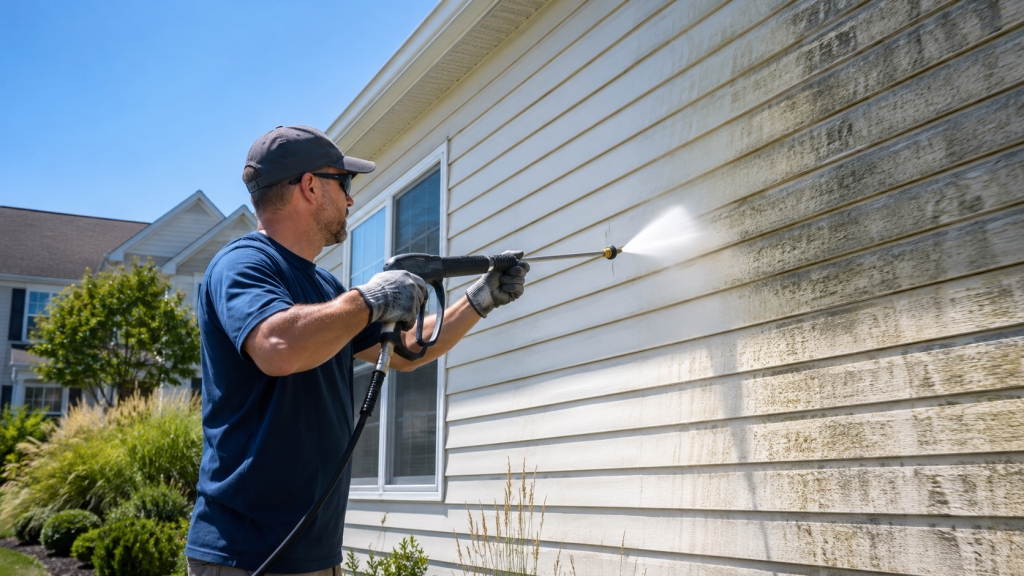
The problem is that the same force is destructive on softer materials. Directed at vinyl siding, it can drive water up behind the panels and into the wall cavity, where it feeds mold you’ll never see until it’s a problem. On wood and cedar it gouges and furs the grain. On stucco it chips and etches. On a roof it strips the protective granules off shingles. High pressure treats every surface like concrete, and most of your home isn’t concrete. That’s why Hose Bros Inc matches the method to the surface rather than blasting everything at one setting.
What soft washing is, and why it lasts longer
Soft washing takes the opposite approach. It uses low pressure — closer to a steady rinse than a blast — combined with a cleaning solution formulated to break down the organic growth that actually discolors a house: algae, mildew, mold, and lichen. The solution does the cleaning; the water just carries it on and rinses it off.
The key advantage isn’t gentleness for its own sake — it’s durability. The green, gray, and black staining on Sussex County homes is biological. It’s living growth with a root structure. When you pressure wash it, you knock off the visible surface layer, but the roots survive and the stain returns within months. When you soft wash it, the solution kills the growth at the root, so the surface stays clean far longer. You’re solving the problem instead of temporarily hiding it. It’s why the Hose Bros soft wash method is used on the majority of home exteriors, with high pressure reserved for hard surfaces that can take it.
A surface-by-surface breakdown
- Vinyl and aluminum siding — soft wash. High pressure forces water behind panels; low pressure plus solution cleans safely.
- Wood and cedar — soft wash, carefully. Pressure raises the grain and strips finish.
- Stucco and brick — soft wash. Pressure chips, etches, and can blow out old mortar.
- Roof shingles — soft wash only. Never pressure wash a roof.
- Concrete driveways, walkways, patios — pressure wash. These are built to take it.
Why the Delaware coast makes soft washing the default
Sussex County’s mix of coastal salt air, high humidity, and heavy tree canopy is close to ideal for the growth soft washing targets. Homes near Lewes, Rehoboth, and Bethany take on salt spray; inland homes around Millsboro, Georgetown, and Milton collect pollen and shade-driven algae. In that environment, the “clean it at the root” logic of soft washing isn’t a preference — it’s what actually holds up between visits. A pressure rinse in this climate is a short-term cosmetic fix; a proper soft wash lasts.
The DIY temptation, and the real math
Rental and consumer pressure washers are cheap and everywhere, which makes DIY tempting. The trouble is that the tool most homeowners can rent is the wrong tool for most of the home, and the damage it causes — water intrusion behind siding, stripped finish, gouged wood, granule loss on a roof — costs far more to repair than a professional wash would have. Soft washing done right is also a skill: matching solution strength to the surface and growth, protecting plantings, and rinsing thoroughly all take experience. Every job at Hose Bros is quoted on-site by time and materials so the method and price match your actual surfaces.
What to ask before you hire
- Will you soft wash or pressure wash my siding, and why?
- How do you protect landscaping and plantings from the cleaning solution?
- Is the roof cleaned with low pressure?
- Do you assess the job on-site, or quote blind?
A contractor who answers “we pressure wash everything” is telling you they use one method regardless of surface — a red flag for a house with vinyl, cedar, or a shingle roof.
How a professional decides which method to use
A good technician doesn’t guess. The decision starts with identifying every surface on the property — vinyl, aluminum, cedar, stucco, brick, concrete — because each has a different tolerance for pressure and a different ideal cleaning solution. Where there’s any doubt, a small, inconspicuous test area confirms how the surface responds before the whole job proceeds. From there, the technician sets the pressure and picks the solution: low-pressure soft washing with a biodegradable cleaner for siding, roofs, and delicate materials, and higher pressure reserved for concrete driveways and walkways that can handle it. Landscaping gets protected — plants are pre-wet and shielded — and the work is sequenced top-down so nothing clean gets re-dirtied. It’s a per-surface decision, not a single setting applied to the whole house, and it’s the difference between a clean that lasts and one that damages.
What a proper soft wash actually includes
Soft washing done right is a sequence, not a spray-and-go. It begins with a walk-around to spot problem areas — heavy algae on north-facing walls, mildew near gutters, stained shaded corners. Plants and delicate fixtures are covered or pre-wet so the cleaning solution can’t harm them. The solution is then applied at low pressure and given the correct dwell time to break down algae, mold, and mildew at the root — this dwell time is where the real cleaning happens, not the water. Stubborn spots are treated again where needed, then the surface is rinsed gently. A final walkthrough confirms the result before the crew leaves. The whole approach protects the material underneath while getting a clean that holds up against Sussex County’s coastal conditions far longer than a quick blast would.
FAQ
Is soft washing less effective than pressure washing? No — it’s more effective on organic growth. Soft washing kills algae and mildew at the root, so results last longer than blasting the surface, which only removes the top layer and lets the growth return.
Can I pressure wash my own siding to save money? It’s risky. Consumer pressure washers can drive water behind vinyl, gouge wood, and strip stucco. The savings disappear the moment you cause damage, which is why exteriors are usually soft-washed with controlled low pressure.
Which surfaces still get high pressure? Hard, durable surfaces: concrete driveways, walkways, and patios. These are built to take the force that would damage siding or a roof.
Where to next: see what pressure washing costs in Sussex County, or learn about the Hose Bros approach to pressure and soft washing.
Published July 2026 · Hose Bros Inc · Serving Millsboro & Sussex County, DE