
Millville · 19967
Pressure washing in Millville
Hose Bros Inc soft washes and pressure washes homes and businesses across Millville. Free estimate, and we’ll tell you straight if you don’t need the work.
Why it’s different here
What Millville does to a house
Millville is the newest town on the Route 26 corridor, and that single fact defines its exterior maintenance profile more than anything else. Where Ocean View and Bethany carry decades of mixed housing stock, Millville is overwhelmingly a product of the last twenty years — Millville by the Sea alone added thousands of homes to what was a crossroads village, and the building has not stopped. That means the town’s surfaces are young: vinyl siding still under warranty, shingles a decade or less into their service life, composite decking and paver hardscaping installed new. Homeowners here frequently assume that new means immune, and it is exactly that assumption that lets the first season of growth establish before anyone recognizes it as a problem rather than a shadow.
The climate does not care how new the material is. Millville sits in the transition zone between the Atlantic and the interior Sussex County farmland, roughly four miles from the ocean, and it catches conditions from both directions. From the east comes the salt-laden air that reaches inland on every onshore breeze — not the direct salt spray of the oceanfront, but a fine salt film that settles on siding and, because salt is hygroscopic, pulls moisture out of the air and holds it against the surface long after a rain has dried everything else. From the west comes the agricultural load: pollen off the fields in spring, dust through the dry stretches of summer, and the organic debris that a rural landscape sheds year-round. Millville gets both, layered on top of each other, in a way the pure oceanfront towns and the pure inland towns do not.
The water geography compounds it. Millville sits near the headwaters of White Creek, which drains south and east toward Indian River Bay, and the low wet ground along the creek keeps ambient humidity elevated well past the point where the surrounding farmland dries out. Summer dew points sit in the low seventies for weeks at a time. Surfaces that face north, or that sit in the shade of the young but fast-growing tree plantings throughout the newer communities, may not fully dry between morning dew and afternoon thunderstorms for the entire month of August. That is not a cosmetic condition. That standing moisture is the growth medium that everything else needs.
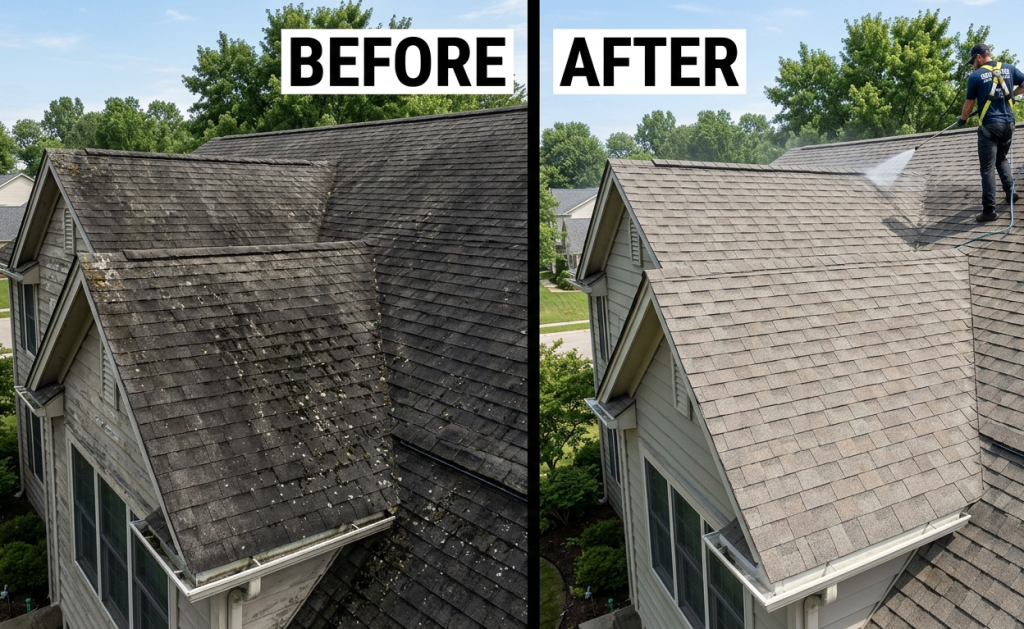
What grows here is the same organism that streaks roofs across coastal Delaware: Gloeocapsa magma, a cyanobacteria that feeds on the limestone filler in asphalt shingles. On the north-facing slopes throughout Millville by the Sea and the older stock along Route 26 it shows as dark streaking, and homeowners routinely mistake it for dirt or for shingle discoloration. It is neither. It is alive, it does not rinse off with water, and it does not come off with pressure — pressure directed at a shingle strips the protective granules, voids the manufacturer warranty that a newer roof still carries, and shortens the roof’s life by years. The correct treatment is a soft wash: a low-pressure application of a sodium hypochlorite solution with a surfactant, allowed to dwell long enough to kill the organism at the root, then rinsed. Dwell time is the active ingredient. Pressure is what damages the roof while accomplishing nothing the chemistry was not already going to do.
On siding the organism is usually a mixed mildew and algae colony rather than the roof cyanobacteria, and the same principle governs it. Vinyl siding does not need to be blasted — it needs to be treated, dwelled, and rinsed at a pressure low enough that water is not driven up behind the laps and into the wall cavity. That intrusion failure is common precisely on the newer construction that dominates Millville, because the siding was engineered to shed wind-driven rain from the outside, not water forced upward from a pressure washer on a ladder. A newer home is not a more forgiving one here. It is a home whose warranties are still live and whose owner has the most to lose from a bad approach.
Hardscaping is its own category and Millville has a great deal of it. The paver patios, walkways, and pool decks throughout the master-planned communities collect a black organic film most homeowners read as ordinary dirt. It is biological, it is genuinely slippery when wet, and it returns within months if the surface is cleaned without treating the growth itself. Concrete driveways collect the same film plus, on the shaded stretches, moss and lichen working into the joints. On paver surfaces there is a further trap: pressure sufficient to strip the film also blows out the polymeric sand in the joints and leaves the field unstable, which on a two-year-old patio is damage the homeowner will notice immediately.
Then there is the HOA factor, and in Millville it is the dominant scheduling force. This is one of the most association-governed towns in Sussex County — the master-planned communities that make up most of its housing carry exterior appearance standards, and a streaked roof or a visibly green driveway is exactly the kind of thing that generates a compliance letter. Owners here are frequently reacting to a deadline set by the association rather than a personal aesthetic threshold, and that concentrates demand and raises the cost of a job that has to be redone because it was done wrong the first time.
Put those factors together and Millville is not a town where exterior cleaning is optional maintenance to be deferred indefinitely. New surfaces still grow. Salt film from the east and agricultural load from the west settle together. The White Creek corridor holds humidity high. Cyanobacteria eats even a young roof. HOA standards set the deadline. The homes are clad in exactly the materials — light vinyl, asphalt shingle, paver, composite — that show all of it from the street. A surface that has gone three or four seasons untreated is a materially harder job than one on an annual cycle, and in a town this new, three or four seasons is often exactly how long it has been since the house was built.
The compounding is worth understanding, because the cost of waiting here is not linear. In the first season growth sits on top of the surface, easily killed and easily rinsed. By the second and third it has worked into the microscopic texture of the vinyl, the pores of the concrete, the granular surface of the shingle. Killing it still works, but removing the dead biomass and the staining it leaves behind takes more chemistry, longer dwell, and more careful rinsing. On a town built to look new, a surface that has quietly aged three seasons past its build date is the most common job on the board — and the one where the gap between doing it right and doing it fast shows up most plainly.
There is also a moisture-management argument that has nothing to do with appearance. Organic growth holds water against whatever it colonizes. On siding that means a wall assembly staying damp longer than it was designed to; on decking it means accelerated rot at fasteners and joist contact points; on a roof it means shingles holding moisture through the handful of freeze-thaw cycles Millville gets each winter. None of that is dramatic in a single season, and all of it is cumulative — and on housing this young, catching it early is the difference between maintenance and repair on materials the owner expected to last decades. That is the whole case for an annual cycle in a town like this: the work is cheap and fast on a surface caught early, and expensive and slow on one left to compound.
On these streets most weeks
Neighborhoods we work in around Millville
Millville by the Sea
The master-planned community that transformed Millville from a quiet Route 26 crossroads into one of Sussex County's fastest-growing towns in barely more than a decade. Thousands of homes across a wide range of product types — single-family, twins, townhomes, and cottage-style — spread across a large acreage with amenity centers, pools, and extensive paver hardscaping. The exterior maintenance profile shifts sharply between product types: single-family homes carry substantial vinyl elevations with north gables that streak first, while the attached-home clusters share long continuous siding runs where mildew spreads laterally between units, so treating one address rarely solves the visual problem for the building. Association appearance standards apply throughout and drive much of the scheduling, so a great deal of the work here is timed to a compliance calendar rather than an owner's own threshold.
Sea Colony West
The inland portion of the Sea Colony community, positioned toward Millville from the Bethany Beach oceanfront section. A mix of condominium buildings, townhomes, and single-family homes with shared amenities and mature landscaping. The shared-wall construction means continuous siding runs and shared roof planes where growth spreads across multiple owners, and the mature tree canopy that makes the community attractive also shades roofs and north elevations, accelerating streaking and keeping those surfaces damp well after the rest of a building has dried.
The Peninsula
An upscale gated golf community on the Indian River Bay side, technically straddling the Millville and Long Neck areas, built around a Jack Nicklaus signature course. High-value homes on larger lots with premium hardscaping, extensive decking, and water-adjacent exposure that raises the humidity and salt load on every surface. Appearance standards are strict and owner expectations are correspondingly high.
Bishops Landing
A large community along the Route 26 corridor with a heavy mix of townhomes and single-family homes, one of the newer additions to the Millville area. Uniform vinyl-and-paver construction across the community means a well-executed job is highly visible to neighbors, and the density of attached product means lateral mildew spread between units is a recurring pattern where treating one address rarely resolves the visual problem for the whole building. Shared amenity hardscaping and pool decks collect the organic film that makes those surfaces slippery, and the community's appearance standards keep exterior condition on owners' minds.
Windmill Village and the Windmill Drive corridor
Established residential development along Windmill Drive, one of the older residential arteries in the immediate Millville area. Housing here predates much of the master-planned boom and carries a more varied construction profile, including some homes far enough into their roof service life that soft washing rather than any pressure application is the only responsible approach, since granule loss on an aging shingle is not recoverable. The mix of ages block to block means the correct method can differ from one house to the next, which is exactly the situation where assessing a property before selecting an approach matters most.
Millville town center and Route 26 frontage
The commercial and mixed-residential core along the main corridor. These properties carry a road-grime component the interior communities do not — traffic film, brake dust, and road spray layered over the same organic growth everyone else deals with. Storefronts, signage, and walkway concrete along this stretch see the highest visibility in town and the fastest re-soiling.
Evergreen Water Front and the White Creek side
Communities and properties oriented toward the White Creek headwaters on Millville's southern and eastern edges. Proximity to the creek and its wetland keeps ambient humidity elevated even by corridor standards, and north and east elevations here stay damp longer and grow more persistently than the same surfaces on the drier western side of town.
Cedar Grove and the western approach
The transition area where Millville's residential development meets the interior farmland to the west. Properties here take the heaviest agricultural pollen and dust load in town, and concrete driveways and walkways show the characteristic organic film and, where pine and hardwood overhang them, tannin staining that pressure alone will not remove.
Dockside and bay-oriented properties
Homes throughout the Millville service area with frontage or deeded access on White Creek or the tributaries feeding Indian River Bay. These carry the heaviest exterior maintenance load in the area — constant ambient moisture, salt exposure from the bay side, and docks, bulkheads, and waterside decking that show growth a full season ahead of the same materials on the street side of the same house. Bulkhead caps and dock boards are the surfaces owners most often let go, partly because they are out of sight from the house and partly because they are assumed to be a lost cause. They are not, but they need an approach that accounts for runoff going straight into tidal water.
Miller's Creek and the southern communities
The developments oriented toward the southern tributaries between Millville and the Selbyville line. Water proximity keeps these properties damp, and the mix of single-family and attached homes carries the same lateral-spread pattern on the shared-wall product that runs throughout the Millville communities. Rear elevations backing onto open space or water take the brunt of morning dew and afternoon shade.
The Refuge at Dirickson Creek
A community on the southern edge of the Millville service area toward Selbyville and the Dirickson Creek watershed, built around a golf course with a mix of single-family homes on generous lots. Water proximity and the golf-course landscaping raise the ambient moisture on every surface, and the larger lots often include fencing, outbuildings, and extensive hardscaping that carry their own maintenance load beyond the house itself.
Coventry and the smaller Route 26 subdivisions
The cluster of smaller single-family subdivisions along and just off Route 26 between Millville and Ocean View. Predominantly vinyl construction with concrete drives and a fairly uniform exterior profile, which makes these neighborhoods ones where a clean, well-executed job stands out immediately to neighbors and generates referral work. Because the lots sit close together, side elevations facing a neighbor at short range get limited airflow and dry slowly, so they grow first and are the surfaces most often missed by a homeowner looking only at the front of the house.
Millville-adjacent Ocean View communities
The eastern edge of the Millville service area blends directly into the Ocean View communities along Route 26, with no hard boundary between them. Bear Trap Dunes and the Ocean View planned communities are within the same corridor and the same service radius, and the maintenance profile carries across the town line unchanged.
Clarksville and the western Route 26 stretch
The crossroads community just west of Millville proper where the corridor begins its transition toward the interior county. Housing is a mix of older established homes on larger lots and newer infill, and the properties here take a heavier agricultural pollen and dust load than the communities closer to the bay. Concrete drives, outbuildings, and fencing are common features that add to the maintenance footprint of a typical property.
Vinyl fencing and outbuildings across the newer communities
Not a neighborhood but a recurring surface pattern worth its own note. Millville's master-planned communities are fenced heavily in white and tan vinyl, and vinyl fencing collects the same mildew and algae as siding while being routinely overlooked until it has gone visibly green. Detached garages, sheds, and pergolas throughout these communities carry the same growth on the same schedule as the houses they sit beside.
Rental turnover cleaning
A house that sits closed up between guests grows algae faster than one that’s lived in, and guests photograph what they see. We schedule around changeover days — tell us your turnovers and we’ll work to them.
The lay of the land
Millville, specifically
- ZIP codes
- 19967
- Water
- White Creek, Indian River Bay, Assawoman Canal, Dirickson Creek, Little Assawoman Bay, Miller Creek, Blackwater Creek, Atlantic Ocean
- Roads & transit
- Route 26 (Atlantic Avenue), Route 17 (Roxana Road), Route 1 (Coastal Highway), Windmill Drive, Cedar Drive, Substation Road, Burbage Road, Route 84, Route 113, Assawoman Canal Trail, DART First State seasonal beach service
- Schools
- Lord Baltimore Elementary School — the elementary school serving the Millville and Ocean View area, part of the Indian River School District, Indian River School District — the public district covering Millville, Ocean View, Dagsboro, Frankford, Selbyville, and Bethany Beach along the Route 26 corridor, Selbyville Middle School — the district middle school serving Millville-area students, south along the Route 113 corridor in Selbyville, Indian River High School — the district high school serving the Millville area, located in Dagsboro to the northwest, whose Friday night athletics function as a regional gathering point, Sussex Academy — a public charter school option in Georgetown drawing students from across Sussex County, Sussex Technical High School — the county vocational-technical high school in Georgetown offering trade and technical programs, Delaware Technical Community College, Owens Campus — the Georgetown campus of Delaware Tech, the primary post-secondary institution serving Sussex County residents
- Landmarks
- Route 26 (Atlantic Avenue) corridor, Millville by the Sea, White Creek, Millville Volunteer Fire Company, Evans Park, The Peninsula Golf and Country Club, Windmill Drive, Indian River Bay, Assawoman Canal, Cedar Neck and the bay approaches, Bethany Beach bandstand and boardwalk, Freeman Arts Pavilion
What we do in Millville
Every service, matched to the surface
Going deeper
More about Millville
Asked in Millville
Questions we actually get
How often should a home in Millville be washed?
Most Millville homes benefit from an annual exterior cleaning, and the reason is specific to this town rather than a general rule. Millville sits in the transition zone between the coast and the interior farmland, so surfaces here take a salt film from the east and an agricultural pollen and dust load from the west, layered together. Add the humidity held in by the White Creek headwaters and the town’s overwhelmingly new, light-colored vinyl housing stock that shows every bit of growth, and an annual cycle is what keeps most homes ahead of it. Properties under the young but fast-growing tree canopy in the master-planned communities, or on the White Creek side, sometimes need attention more often on north-facing elevations. A home that has gone three or four seasons untreated is a materially harder job than one on a yearly cycle — and in a town this new, three or four seasons is often exactly how long it has been since the house was built.
Is pressure washing safe for my roof?
Pressure washing an asphalt shingle roof is not safe and should not be done, and this matters more in Millville than in most places because so many roofs here are still under manufacturer warranty. The pressure strips the granules that protect the shingle from ultraviolet damage, shortens the roof’s life measurably, and voids most warranties outright. The dark streaking on north-facing slopes throughout Millville by the Sea and the older Route 26 stock is Gloeocapsa magma, a cyanobacteria that feeds on the limestone filler in the shingle. It is a living organism, not a deposit, and no amount of pressure removes it permanently because pressure does not kill it at the root. The correct method is a soft wash: a low-pressure application of a sodium hypochlorite solution with a surfactant, allowed to dwell long enough to kill the organism, then rinsed. Any operator who proposes high pressure on your shingles is telling you they do not understand the surface they are standing on.
Will washing damage my vinyl siding?
Not when it is done correctly, and vinyl is genuinely well suited to this work. The risk is not the vinyl itself — it is water driven up behind the laps and into the wall cavity by excessive pressure or a bad approach angle. That is a real failure mode and a common one on newer construction, because siding is designed to shed wind-driven rain coming down and in, not water forced upward from a ladder. A proper soft wash uses chemistry and dwell time to kill the growth and low pressure to rinse it away, which cleans more thoroughly than blasting while eliminating the intrusion risk entirely. On a newer Millville home whose siding is still under warranty, that distinction is not academic — it is the difference between a maintained warranty and a voided one.
What causes the black streaks on my driveway and patio?
The black film on concrete and pavers in Millville is almost always biological — a mixed algae and mildew colony feeding on the moisture the surface holds and the organic debris that settles on it from both the coastal humidity and the agricultural fields to the west. It is slippery when wet and a genuine fall hazard on pool decks and walkways. The rust-brown staining is a separate problem: tannin leached from pine needles, sap, and leaf litter, which penetrates the surface rather than sitting on top of it and will not come out with pressure alone regardless of how much is applied. On the paver surfaces that are everywhere in Millville’s master-planned communities there is a further consideration, because pressure sufficient to remove the film will also blow out the polymeric sand in the joints and destabilize the field — damage that shows immediately on a newer patio.
When is the best time of year to schedule?
Spring is the strongest window for most Millville properties. The pollen load comes off the surrounding fields and the tree plantings in April and May and coats every horizontal surface in town, so cleaning after it drops rather than before means the result lasts. Owners preparing rental properties for the season need the work finished before the first booking, which concentrates demand into a narrow period and makes early scheduling worthwhile. Fall is the other sensible window, clearing the summer’s growth and the leaf and needle drop before winter. Summer work is entirely possible, but the Route 26 corridor congestion between Memorial Day and Labor Day affects scheduling flexibility for everyone. Winter is workable on milder days and is often the easiest time to get on the calendar.
Do I need to be home when the work is done?
No. Exterior cleaning is done entirely from outside the structure and does not require interior access, so most Millville jobs are completed without the owner present. That matters here more than in most markets, given how much of the town’s housing is second homes and rentals whose owners are not local for much of the year. What is needed is access to an exterior water spigot and clear approach to the elevations being treated, with vehicles, patio furniture, and grills moved clear. Because so much of Millville sits inside gated or access-controlled communities, arranging entry in advance is often the single most important scheduling detail.
Should I be concerned about my plants and landscaping?
It is a fair concern and it deserves a real answer rather than reassurance. The solutions used in soft washing can damage vegetation if a property is not properly prepared, and the young, heavily landscaped lots throughout Millville’s newer communities have a great deal of fresh planting to protect. Correct practice is to pre-wet plantings thoroughly before any application, protect sensitive material where needed, and rinse the surrounding landscape afterward so nothing is left to concentrate as it dries. Done that way, damage is avoidable. Done carelessly, it is not, and it is a reasonable thing to ask any operator about directly before hiring them.
Why does the growth come back so quickly on some homes?
Two reasons, usually distinguishable. The first is method: if a surface was cleaned with pressure alone and no treatment, the visible growth was removed but the organism was left alive in the surface, and it regrows from what remains — sometimes within a single season. The second is site conditions. A north-facing elevation shaded by the fast-growing tree plantings common throughout Millville’s master-planned communities, or a surface on the damp White Creek side of town, receives little direct sun and dries slowly after every rain, so it will always carry more pressure than a south elevation in full sun on the same house. That is not a failure of the cleaning; it is the site, and properties in those conditions do better on a consistent maintenance cycle than on an occasional reactive one.
Get a free estimate in Millville
Call (302) 945-9470. We work Millville most weeks.