
Selbyville · 19947
Pressure washing in Selbyville
Hose Bros Inc soft washes and pressure washes homes and businesses across Selbyville. Free estimate, and we’ll tell you straight if you don’t need the work.
Why it’s different here
What Selbyville does to a house
Selbyville sits in a transition zone that almost no other town in our service area occupies, and that position is the whole reason exterior surfaces here fail differently than they do six miles up the road. The town straddles the line where coastal Sussex County stops being coastal and starts being farmland. Little Assawoman Bay is roughly four miles east. The Atlantic is under six. West of Route 113, the land opens into corn, soybean, and poultry country that runs unbroken to the Maryland line and beyond. A house in Selbyville gets weather off the water and weather off the fields, and the two load its siding, roof, and hardscape with completely different material.
From the east comes salt aerosol. Onshore wind carries fine sodium chloride inland as a suspended mist, and it does not stop at the beach towns. It settles on north and east elevations, holds moisture against the substrate long after a rain has dried elsewhere on the structure, and gives algae and mildew a damp surface to colonize weeks longer per season than an inland house would offer. Salt is also mildly hygroscopic, meaning it actively pulls humidity out of the air onto the surface it is sitting on. On vinyl siding, which is the dominant cladding across the Route 54 communities, that produces the gray-green film homeowners here describe as looking dirty within a season of being washed.
From the west comes agricultural and organic particulate. Sussex County is one of the densest broiler-producing regions in the country, and Selbyville sits at the heart of it with the Mountaire Farms complex inside town limits. Field work, harvest dust, poultry house ventilation, and truck traffic on 113 and 54 all put fine organic solids into the air. That material is nutritive. Unlike road grit, which is inert and rinses, organic particulate feeds the biological growth that salt moisture has already made possible. This is the specific pairing that makes Selbyville harder than either a pure beach town or a pure inland town. Fenwick Island gets the salt without the field load. Bridgeville gets the field load without the salt. Selbyville gets both, and they compound.
The tree canopy adds the third input. Loblolly pine and sweetgum dominate the older sections of town and the wooded edges of the newer communities. Pine drops sap and needles that hold moisture against roofing and decking. Sweetgum and oak drop tannin-heavy leaf litter that stains concrete, pavers, and composite decking a rust brown that pressure alone will not lift. Tannin is a chemical stain, not a soil, and it requires the right cleaning agent rather than more pressure. A contractor who reaches for higher PSI on a tannin-stained paver patio in Selbyville will etch the paver and leave the stain.
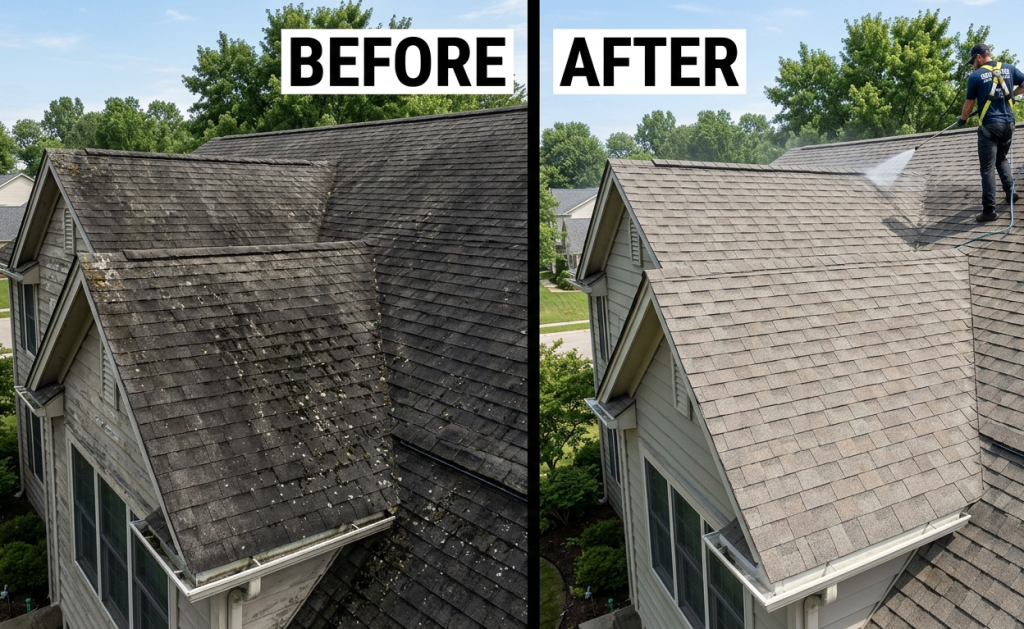
Topography completes the picture. This part of Sussex is flat, the water table is high, and drainage is slow. Surfaces here stay wet. Slabs, walkways, pool decks, and the north faces of roofs hold moisture measurably longer than the same surfaces would on higher ground, and Gloeocapsa magma, the cyanobacteria responsible for the black streaking on asphalt shingles, needs exactly that: a persistently damp, north-facing, low-UV surface with organic material available. The streaking that shows up on Selbyville roofs is not dirt and does not respond to rinsing. It is a living organism with a root structure into the shingle mat, and removing it requires a soft wash chemistry that kills the organism rather than a pressure approach that strips granules off the shingle and shortens the roof’s life.
The building stock concentrates all of this. Most of the residential growth in the Selbyville ZIP over the past two decades has happened in planned communities off Route 54 heading toward Fenwick, and those homes share a construction profile: vinyl siding, asphalt shingle roofs, vinyl or composite fencing, paver or stamped concrete patios, and in many cases a pool deck. Every one of those surfaces is on the list of things that biological growth attacks first. Many of those communities also carry appearance covenants, which means a homeowner is not simply choosing whether to clean but is often responding to an HOA letter with a deadline attached.
Finally, occupancy patterns shape when the work happens. A meaningful share of Selbyville-area properties are second homes or seasonal rentals serving the Fenwick and Ocean City markets. Those properties sit closed through winter with no one to notice a problem developing, then need to present well for spring opening, and need attention again at fall closing. The result is a cleaning calendar driven by turnover dates rather than by whenever an owner happens to look up and see streaking.
All of this changes what correct work looks like here. A Selbyville property usually presents more than one problem at once, and the problems do not share a solution. Salt film on siding, biological streaking on a north-facing roof, tannin staining on a paver patio, and traffic grime on a road-facing elevation are four different failures requiring four different chemistries and four different pressure levels on the same visit. Treating them as one job with one setting is how surfaces get damaged: shingle granules stripped from a roof, vinyl siding chalked and oxidized, paver surfaces etched down to exposed aggregate, and mortar joints blown out of a walkway. The correct sequence starts with identifying which of the two prevailing loads, marine or agricultural, is dominant on a given elevation, then matching the approach to the substrate rather than to the appearance of the soil. That assessment is not something a contractor unfamiliar with this specific stretch of Sussex County tends to make, and it is the difference between a house that stays clean through a season and one that looks the same again by August.
On these streets most weeks
Neighborhoods we work in around Selbyville
Bayside
The largest planned community in the Selbyville ZIP, built around a Jack Nicklaus Signature golf course off Route 54. Homes here span single-family, townhome, and condominium product, most with vinyl or fiber cement cladding and asphalt shingle roofs. The community sits on relatively open ground with long sight lines to Assawoman Bay, which means unobstructed onshore wind and heavier salt deposition on east and north elevations than the wooded sections of town see. Appearance standards are enforced, and exterior cleaning is frequently prompted by a covenant notice rather than by owner initiative. The scale of the community also means shared amenity surfaces, clubhouse walkways, and pool decking carry their own maintenance cycle separate from individual homes.
Keenwick Sound
A waterfront community on the north side of Route 54 with direct frontage and boat access to Little Assawoman Bay. Proximity to open brackish water puts these homes in the highest salt-exposure tier in the Selbyville area. Bulkheads, docks, and boat lifts add marine-grade surfaces to the typical residential cleaning scope, and the constant humidity off the water keeps siding damp enough that mildew regrowth intervals run shorter here than anywhere else in town. Salt-tolerant approaches matter here more than anywhere in the ZIP, and rinse thoroughness on the waterside elevations determines how long the result actually holds.
Swann Keys
A canal-front community off Route 54 where nearly every lot backs to water. The canal system holds humidity at ground level, and homes sit close together, which limits air movement and drying between structures. Vinyl siding on the shaded elevations between neighboring homes is where growth appears first. Many properties here are seasonal rentals, so cleaning tends to cluster around spring opening and fall closing rather than being spread through the year. Access between tightly spaced homes requires equipment that can reach without staging on a neighboring lot.
Cape Windsor
A waterfront and canal community at the eastern edge of the Selbyville ZIP, close enough to Fenwick Island to take the full marine load. Docks, bulkheads, and waterside decking are standard, and the salt exposure here is essentially coastal rather than transitional. Composite and pressure-treated decking in this community shows the gray oxidation and mildew pattern typical of surfaces that never fully dry between weather events. Composite requires a fundamentally different approach than wood, and using wood-appropriate pressure on composite boards permanently marks the surface.
Mallard Lakes
An established community off Route 54 with a mature tree canopy and pond frontage on several sections. The canopy is the defining factor here: pine sap and needle drop on roofs, tannin staining from hardwood leaf litter on concrete and pavers, and heavy shading that keeps north elevations damp. Roof streaking tends to be more advanced in Mallard Lakes than in the open communities because low UV exposure lets Gloeocapsa magma establish without interruption. Gutter loading from needle and leaf drop is correspondingly heavier, and overflow staining down siding is a common secondary problem.
Bayville Shores
A community near the Fenwick Island approach with a mix of single-family and attached homes. Its position between the bay and the Route 54 corridor gives it both salt exposure and road film from one of the busiest seasonal traffic routes in southern Delaware. Vinyl siding facing the roadway picks up a distinct traffic grime layer that sits on top of the biological growth and requires a different approach than the sheltered elevations. Removing the grime without addressing the growth underneath produces a result that looks clean for a matter of weeks.
The Refuge at Dirickson Creek
A golf community west of Route 54 built around Dirickson Creek, with wooded lots and creek frontage. The creek moderates humidity upward across the community, and the wooded setting brings the same tannin and sap issues seen in Mallard Lakes. Larger lot sizes here mean longer driveways and more hardscape square footage per property than the denser communities to the east. Driveway square footage often exceeds the house wash scope on these properties, which changes how the work is sequenced and scheduled.
Americana Bayside
Part of the broader Bayside development with its own section character, oriented toward the Route 54 side. Homes carry the same vinyl and shingle profile as the wider community and the same covenant expectations around exterior appearance. Its slightly more inland position means marginally less salt than the bay-facing sections but more exposure to agricultural particulate carried from the fields west of 113. The practical effect is a soil profile that reads more organic and less mineral than the waterfront sections.
Lighthouse Lakes
A community along the Route 54 corridor toward Fenwick, named for the Fenwick Island Lighthouse that anchors the area's identity. Pond and water features throughout the community raise ambient humidity, and the open layout gives onshore wind clean access to most elevations. Pool decks and patios are common and are typically the first surfaces where owners notice slip-risk biological growth developing. Pool surrounds carry a genuine safety dimension that siding does not, and they tend to drive the timing of the first call.
Windmill Village
An established residential section of Selbyville with a mix of housing ages and construction types. Older homes here may carry original vinyl or aluminum siding, painted trim, and concrete rather than paver hardscape, all of which respond differently to cleaning than the newer resort-community building stock. Aluminum siding in particular requires low-pressure treatment to avoid oxidation streaking, and painted wood trim in this section will not tolerate the pressure appropriate for modern vinyl. Older concrete walks here may also have surface spalling that cleaning can worsen if approached incorrectly.
Dirickson Creek
The waterfront and near-water properties along the creek itself, west of the Route 54 communities. Brackish water frontage, mature trees, and slow drainage combine here, producing the fullest version of the Selbyville surface problem: salt, organic particulate, tannin, and persistent moisture on the same structure. Docks and bulkheads are common additions to residential scope. Marine-adjacent structures accumulate a different growth profile than house surfaces and generally need attention on a separate, shorter interval.
Downtown Selbyville
The historic core around Church Street and Main Street, including the town's older housing stock, municipal buildings, and small commercial frontage. Building materials here skew older, including painted wood siding, brick, and original concrete walks, none of which tolerate the pressure levels appropriate for modern vinyl. This section also sits closest to the Route 113 corridor and carries the heaviest traffic film load in the ZIP. Commercial storefronts here have presentation requirements that residential properties do not, and their cleaning cycles tend to be driven by foot traffic seasons.
Williamsville
A small locality on the northwestern edge of the Selbyville area, closer to the agricultural land than to the water. Salt exposure drops noticeably here while field-borne dust and organic particulate rise. Properties are typically on well water rather than municipal supply, which introduces mineral content that can leave spotting if a surface is left to air dry after cleaning. Working from a supplied water source rather than the property's own well avoids that problem on glass and dark siding.
Roxana
An unincorporated area north of Selbyville toward Frankford, sitting squarely in the transition between coastal and agricultural conditions. Larger lots, more outbuildings, and more agricultural structures appear in the residential mix here, which broadens typical cleaning scope beyond house and driveway to include barns, pole buildings, and equipment pads. Metal roofing and metal siding are far more common here than in the corridor communities, and both require chemistry chosen to avoid corroding fasteners and finishes.
Frankford edge and Route 20 corridor
The residential and small-farm properties along the northern approach to Selbyville toward Frankford, where corridor development thins into agricultural land. Exposure here is dominated by field-borne particulate rather than salt, and properties tend toward larger lots, longer driveways, and detached outbuildings that broaden the scope of typical exterior work.
Rental turnover cleaning
A house that sits closed up between guests grows algae faster than one that’s lived in, and guests photograph what they see. We schedule around changeover days — tell us your turnovers and we’ll work to them.
The lay of the land
Selbyville, specifically
- ZIP codes
- 19947
- Water
- Municipal water, private well water, brackish surface water, high water table, hard water mineral content, seasonal irrigation
- Roads & transit
- Selbyville’s road network is organized around two routes that intersect just outside the historic town center, and understanding that intersection explains most of how the area functions. US Route 113 runs north and south, connecting Selbyville to Frankford, Dagsboro, Millsboro, and Georgetown to the north, and crossing into Maryland toward Berlin and Snow Hill to the south. It is the primary commercial and freight corridor for this part of Sussex County, carrying agricultural traffic, poultry industry transport, and through traffic between Delaware and the Maryland Eastern Shore. Delaware Route 54, known locally as Lighthouse Road, runs east from the Route 113 intersection toward Fenwick Island and the Atlantic. Route 54 is the spine of the residential growth that has defined the Selbyville area over the past two decades, and nearly every planned community in the ZIP takes access from it. In summer it functions as one of the primary beach access routes for the Fenwick and north Ocean City area, and traffic volumes shift dramatically between season and off-season. Distance and drive time from Selbyville put a large service area within practical reach. Fenwick Island is a short drive east on Route 54. Ocean City, Maryland lies just south across the state line. Bethany Beach is a straightforward run north and east. Millsboro, Dagsboro, and Frankford are all accessible north on 113, and Georgetown, the county seat, sits roughly twenty miles north. The area has no passenger rail service and limited fixed-route public transit. DART First State operates seasonal beach service in the coastal corridor, but the practical reality for residents and service businesses alike is that this is a vehicle-dependent market. Nearest commercial air service is Salisbury Regional in Maryland, with Baltimore Washington International and Philadelphia serving as the primary long-haul airports for the second-home population. Seasonal congestion on Route 54 is a genuine scheduling factor for any service business working the corridor. Summer weekend traffic between Route 113 and Fenwick Island can extend a short trip considerably, which shapes how routes are sequenced and why early-day scheduling matters here more than it does inland. Secondary roads carry more of the local traffic than the numbered routes suggest. Route 20 connects Selbyville west toward Dagsboro and the inland communities, and a network of county roads links the agricultural areas, Roxana, Williamsville, and the scattered residential development between the corridor and the Maryland line. Many of these are two-lane roads without shoulders, which affects both access and equipment staging on rural properties. The Transpeninsular Line, marked at Fenwick Island, defines the Delaware and Maryland border just south of town, and the practical reality of that border is that daily life in Selbyville crosses it constantly. Residents routinely shop, work, dine, and seek services in Bishopville, Berlin, and Ocean City, and the state line functions as an administrative boundary rather than a meaningful separation of the local economy. Boat access is a genuine transportation consideration in the waterfront communities. Swann Keys, Keenwick Sound, Cape Windsor, and the Dirickson Creek properties all provide direct or community water access to Little Assawoman Bay and the connected inland bay system, and for many households a boat is a functional part of how the property is used rather than solely recreational.
- Schools
- Phillip C. Showell Elementary School | The public elementary school serving Selbyville, part of the Indian River School District. Located in town, it is one of the primary anchors of family life in the community and a common reference point when residents describe where they live relative to the rest of town., Selbyville Middle School | The Indian River School District middle school serving Selbyville and surrounding communities, drawing students from the town, the Route 54 corridor communities, and the surrounding rural areas including Roxana and Williamsville., Indian River High School | The district high school serving Selbyville-area students, located in nearby Dagsboro. The commute pattern from Selbyville to Dagsboro along Route 113 and Route 26 is a familiar daily route for local families., Indian River School District | The public school district covering southeastern Sussex County, including Selbyville, Frankford, Dagsboro, Millsboro, Ocean View, and Bethany Beach. District boundaries are a common frame of reference for families choosing between communities in this part of the county., Sussex Academy | A public charter school option in Georgetown drawing students from across Sussex County, including Selbyville families willing to make the roughly twenty-mile commute north on Route 113., Delaware Technical Community College, Owens Campus | The Georgetown campus serving southern Delaware with associate degree and workforce training programs, and the nearest higher education option for Selbyville residents. Programs span nursing, allied health, culinary, automotive, and building trades, and the campus is a common path for Indian River graduates entering skilled work locally., Selbyville Head Start and early childhood programs | Early education services operating in the Selbyville area, supporting working families across the town and the surrounding agricultural community, and often a family’s first point of contact with the local education system., Most Blessed Sacrament Catholic School | A private school option in nearby Berlin, Maryland, drawing families from the Selbyville area who prefer parochial education, a short drive south across the state line., Worcester Preparatory School | An independent college preparatory school in Berlin, Maryland serving students from both sides of the Delaware and Maryland line, including families from the Selbyville and Fenwick corridor.
- Landmarks
- Selbyville Water Tower, Mountaire Farms Selbyville Complex, Freeman Arts Pavilion, Selbyville Town Hall, Fenwick Island Lighthouse, Bayside Clubhouse, Old Timers Museum, Route 113 and Route 54 Intersection, St. George’s and Selbyville United Methodist Church, Assawoman Canal, Bayside Beach Club
What we do in Selbyville
Every service, matched to the surface
Asked in Selbyville
Questions we actually get
Why does mildew come back faster on my Selbyville house than at my old inland home?
Selbyville sits in a transition zone that gets salt aerosol off Little Assawoman Bay and the Atlantic from the east, plus agricultural and organic particulate off the farmland and poultry operations to the west. Salt is hygroscopic, meaning it pulls humidity out of the air and holds it against your siding, and the organic particulate provides nutrition for growth. Neither input alone is unusual. The combination is what makes this market harder than either a pure beach town or a pure inland town, and it is why regrowth intervals here run shorter than most homeowners expect.
Should my roof be pressure washed or soft washed?
Asphalt shingle roofs should always be soft washed, never pressure washed. The black streaking on Sussex County roofs is Gloeocapsa magma, a cyanobacteria with a root structure that grows into the shingle mat. Pressure removes the visible surface layer while stripping protective granules and shortening the roof’s service life, and the organism regrows from what remains. A soft wash applies a cleaning solution that kills the organism at low pressure, so the roof stays clean substantially longer and the shingle is not damaged. Most shingle manufacturers specify low-pressure cleaning in their warranty terms.
What causes the rust-brown stains on my paver patio?
Those are almost always tannin stains from hardwood leaf litter, particularly oak and sweetgum, both common across the wooded Selbyville communities. Tannin is a chemical stain rather than a surface soil, which is why increasing pressure does not remove it and often damages the paver instead by eroding the surface and exposing aggregate. Tannin requires the correct cleaning agent and appropriate dwell time. Pine sap creates a related problem and responds to a different treatment.
How often should exterior cleaning be scheduled here?
Most Selbyville-area homes benefit from house washing on an annual cycle, though properties in the highest-exposure locations, particularly waterfront homes in Keenwick Sound, Swann Keys, and Cape Windsor, often need it more frequently. Roof soft washing typically runs on a longer cycle than siding. Heavily shaded properties in communities like Mallard Lakes and The Refuge at Dirickson Creek generally need attention sooner than homes on open lots, because low UV exposure and slower drying let growth establish faster.
Can exterior cleaning be scheduled while I am not at the property?
Yes, and it is common here. A large share of Selbyville-area properties are second homes or seasonal rentals whose owners live elsewhere, and exterior work does not require anyone on site. What is needed is water access and a clear path around the structure. Before and after documentation can be provided so an absentee owner can verify completion, which also serves as a record for HOA compliance where a covenant notice prompted the work.
Will cleaning damage my landscaping?
Proper exterior cleaning protects plantings as part of the standard process, through pre-wetting, appropriate solution dilution, and thorough rinsing of surrounding beds and turf. The risk comes from improper technique rather than from cleaning itself. Homeowners should be cautious of any contractor who does not discuss plant protection before beginning, particularly on soft wash work where solution contact with foliage is the primary concern.
Does my HOA require a specific approach to exterior cleaning?
Several Selbyville-area communities, including sections of Bayside and the Route 54 developments, maintain appearance covenants that address exterior condition, and many homeowners first schedule cleaning in response to a notice with a compliance deadline. Requirements vary by community, and some address contractor insurance or scheduling restrictions during peak season. It is worth confirming your community’s specific standards, and documentation of completed work is often useful for the compliance record.
What is the best time of year for exterior cleaning in Selbyville?
Spring is the heaviest demand period, driven by seasonal property opening across the Route 54 corridor, with a secondary peak in fall as owners prepare properties for winter closing. Work can be performed through most of the year given suitable temperatures. Because Route 54 traffic increases substantially through the summer season, scheduling outside peak weekends is generally easier for both routing and property access.
Get a free estimate in Selbyville
Call (302) 945-9470. We work Selbyville most weeks.