
Rehoboth Beach · 19971

Pressure washing in Rehoboth Beach

Hose Bros Inc soft washes and pressure washes homes and businesses across Rehoboth Beach. Free estimate, and we’ll tell you straight if you don’t need the work.

Get a free quote Call (302) 945-9470

Why it’s different here

What Rehoboth Beach does to a house

Rehoboth Beach is two blocks from the Atlantic, and salt is the whole story. Salt is hygroscopic — it pulls moisture out of the air and holds it against your siding, so surfaces here stay damp long after the sun is out, even on days it never rains. An inland home gets wet and then dries; a Rehoboth home gets wet and then stays humid at the surface, because the salt deposited on it keeps drawing water back out of the ocean air. That’s the difference between here and Georgetown, twenty minutes inland, and it’s why homes in this town grow algae at a pace that genuinely surprises people who move from anywhere else. It isn’t the humidity number on the weather app — Georgetown’s is similar. It’s the salt holding that humidity against the surface around the clock.

Then there’s what the census says about who’s actually home to notice: 74 percent of Rehoboth housing units sit vacant — second homes and vacation rentals that stand closed up between stays. A house with no airflow, no windows opening, no one running the HVAC, and salt-damp siding grows faster than an occupied one, and most of this town is that house. Owners arrive in May to a green north wall and assume something happened over the winter. Nothing happened — the house just did what unattended coastal houses do, which is why the smart rental owners here run exterior care on a calendar instead of on a surprise.

The third factor is the housing itself. The median Rehoboth home was built in 1975, and nearly a fifth of the stock predates 1940 — South Rehoboth’s Victorians, Henlopen Acres’ cedar shake, painted wood trim everywhere you look between the Avenue and Silver Lake. Those surfaces cannot take high pressure: the grain raises, the paint strips, the shake splits, and water gets driven into wood that has stayed sound for a century precisely because nobody ever forced water into it. In a town where the median property value hit $1.49 million in 2024 — up 20 percent in a single year — wand marks on hundred-year-old trim are a five-figure mistake, and we’ve been called to look at more than one.

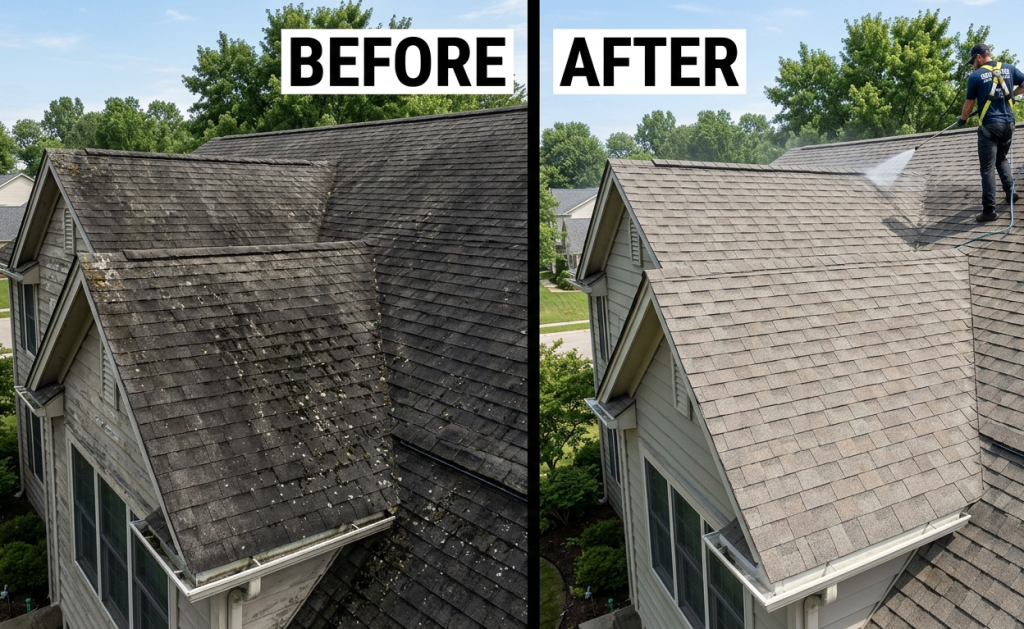
What the growth actually is matters too, because three different organisms get blamed on “dirt” here. The green film on shaded siding is algae, feeding on moisture and whatever organic material settles into the surface texture. The black streaks running down roofs are Gloeocapsa magma, a blue-green algae that eats the limestone filler in asphalt shingles and thrives in exactly this climate — humid, salt-damp, pine-shaded. And the fuzzy growth in deck boards and fence posts is true mildew, living in the grain rather than on it. All three are alive, which is the whole point: knock the visible layer off with pressure and the organism underneath grows back, usually within a season, because nothing about the moisture or the food supply changed.

Geography closes the loop. Silver Lake and Lake Comegys put spring-fed freshwater against the south end of town, the Lewes-Rehoboth Canal runs the northwest boundary, and Rehoboth Bay sits behind it all — so even the blocks that don’t face the ocean face water. The Pines adds tree cover to the equation: pine shade means siding that never fully dries and needle drop that feeds roof algae year-round. Put it together and Rehoboth is ringed and roofed by moisture on every side, with a housing stock too delicate for shortcuts and a majority of owners not present to watch the green arrive.

There’s also a rhythm to it that inland towns don’t have. Rehoboth’s growth calendar runs on the rental season: exteriors get inspected in April when owners and property managers arrive, photographed in June when listings refresh, and ignored from October to March while the salt keeps working. That’s backwards from the biology — the growth compounds exactly during the months nobody’s looking — which is why the houses that stay clean here are the ones on a standing fall-and-spring rhythm rather than a panic-in-May one.

And the stakes are simply higher per square foot than anywhere else in the county. When the median property is worth $1.49 million, exterior condition isn’t cosmetic — it’s listing photos, rental bookings, and appraisal value. A green north wall on a Millsboro rancher is an eyesore; on a South Rehoboth Victorian it’s a line item. So the Rehoboth pattern, plainly: salt-held moisture on everything, most homes empty and growing unwatched, delicate high-value surfaces that demand soft washing over blasting — and a fix that follows the diagnosis: low pressure and a solution that kills the growth at the root on anything delicate, real pressure only on the concrete and pavers that can take it, and a schedule set by your block’s exposure rather than a one-size calendar. That’s not upsell logic; it’s what the map and the census already say about this town.
One more thing the brochures skip: storms. Rehoboth sits exposed to nor’easters, and the town’s modern shape literally comes from one — the Ash Wednesday storm of 1962 wrecked the boardwalk and much of the oceanfront, and the beach has been rebuilt and replenished more than once since. Day to day, that exposure shows up smaller but constantly: a good coastal blow drives salt spray blocks inland, and the film it leaves on windows, siding, and railings is why an oceanside exterior can look dull a week after it was cleaned by rain alone. Wind-driven salt is also why the ocean-facing sides of homes in North Shores and Henlopen Acres age differently than their own street-facing sides — same house, two weather patterns. It’s not a reason to panic; it’s a reason the maintenance rhythm here is a rhythm, and why the houses that always look right in this town are the ones whose owners treat the exterior like the roof — on a schedule, not on a whim.
And if you only remember one thing from all of this, make it the simplest: green that comes back a season after it was blasted off didn’t survive the cleaning — it survived the method. Killing the organism is the job; removing its top layer is just rearranging it. In Rehoboth’s conditions, that difference is the whole difference between an exterior that holds for years and one that’s green again by the next changeover.

On these streets most weeks

Neighborhoods we work in around Rehoboth Beach

South Rehoboth

The blocks between Rehoboth Avenue and Silver Lake are the town's Victorian heart — turn-of-the-century cottages with painted wood trim, porch detail, and original siding older than the state highway system. Nearly a fifth of Rehoboth's housing predates 1940 and most of it is concentrated here. That trim is exactly what high pressure destroys: raised grain, stripped paint, water driven into hundred-year-old wood. On streets where the median property runs past a million dollars, everything gets soft washed, and the growth pattern is classic salt-side Rehoboth — green film on the shaded north faces, mildew in the porch shadows, and salt grime dulling the paint a block at a time.

North Rehoboth / The Pines

The pine canopy along Columbia and the surrounding blocks is what people love about this end of town, and it's also why these homes carry the heaviest algae load in the city. Shade means siding that never fully dries, and the pines drop needles and sap on roofs year-round — organic material that feeds Gloeocapsa magma, the black-streak roof algae. Homes here green up first and regrow fastest, entirely because of the trees, not the upkeep. The honest schedule in The Pines is more frequent than anywhere else in walking distance of the beach, and roof soft washing is half the work we do on these blocks.

Henlopen Acres

A private enclave of cedar shake and painted siding sitting directly against Cape Henlopen State Park, with nothing between these homes and the Atlantic but dune grass. Full ocean exposure meets the most delicate surfaces in town: cedar shake splits and furs under pressure, and the salt load this close to open water means surfaces hold moisture continuously. Henlopen Acres work is exclusively soft wash, done carefully, on homes whose owners have usually seen at least one exterior ruined by somebody's pressure wand before they found us. The combination of exposure and material makes this the most technique-sensitive neighborhood in Rehoboth.

North Shores

Oceanfront and canal-side homes north of town taking direct Atlantic salt on one side and Lewes-Rehoboth Canal humidity on the other — moisture from two directions with no dry season. North Shores homes show the fastest regrowth rate anywhere in the Rehoboth area: an exterior cleaned in April can show green by the following spring as a matter of course, not neglect. Owners here are mostly seasonal, which compounds it — houses sit closed up through the exact months the salt works hardest. A standing yearly schedule, timed before the owner's first arrival, is the only approach that keeps these exteriors ahead of the water.

Silver Lake Shores & Spring Lake

Lakefront lots around Silver Lake and Lake Comegys get the freshwater version of Rehoboth's salt problem: constant humidity off the water, plus shade from the mature trees that make these streets beautiful. The lake side of a Silver Lake Shores home can be visibly greener than the street side of the same house — same siding, same owner, different moisture. These are also some of Rehoboth's most photographed blocks, herons and waterfowl included, and runoff discipline matters here: containment and rinse practices that keep cleaning solution out of a spring-fed lake are non-negotiable, because that lake is the property value.

The Glade & Sawgrass

The wooded communities west of Route 1 trade the ocean block for tree cover and larger lots — and inherit the shade problem that comes with them. Paver patios and walkways grow moss in the joints under the canopy, composite decks carry the same surface film as everything else in town, and the tree-side walls of these homes stay damp into the afternoon. The work here is less about salt and more about shade and organic debris: soft washing siding, cleaning and re-sanding paver joints, and decks that want low pressure and the right solution rather than force.

Rehoboth Beach Yacht & Country Club

The established golf community on Rehoboth Bay carries the most hardscaping per home in the area — wide driveways, paver patios, pool surrounds — plus a large second-home share that sits closed up in the off-season. Bay-side humidity is gentler than ocean-front salt but it never stops, and hardscape here goes slick and green by midsummer on the shaded exposures. A lot of our Yacht & Country Club work is the full-property version: siding soft wash, concrete and paver pressure work, and pool-deck cleaning in one visit, scheduled in the spring window before the owners arrive for the season.

Country Club Estates

The mid-century neighborhood off the Avenue extended — ranchers and split-levels from the fifties and sixties on generous lots, one of the few parts of town where year-round families are the norm rather than the exception. The siding here is a full generation newer than South Rehoboth's Victorians but a full generation older than anything at the outlets end of Route 1, which means aluminum and early vinyl that's oxidized with age. Oxidized siding chalks, and aggressive pressure leaves permanent wand stripes in chalked siding — so Country Club Estates gets soft washed, and where the oxidation is heavy we say plainly what's cleanable and what's a repaint conversation.

Kings Creek Country Club

The gated golf community on the bay side of Route 1 — larger contemporary homes around the course, heavy hardscaping, and the bay-side moisture pattern: gentler than ocean-front salt but constant, with the shaded fairway lots holding damp the longest. The mix of work here is the full-property kind — siding soft wash, driveway and paver pressure work, pool surrounds — usually scheduled in the spring window before the season, and the HOA-adjacent appearance standards mean owners here tend to run on a calendar rather than waiting for the green to announce itself.

The Grande at Canal Pointe

The newer townhome-and-condo community along the Lewes-Rehoboth Canal side — modern vinyl and composite construction that's the easiest surface set in town to keep clean and the most obvious when it isn't, because film and pollen show on fresh light-colored siding immediately. Shared walls mean shared shade lines, where growth starts on one unit's north face and walks down the row, and canal-side humidity keeps the back exposures damp. Community appearance standards apply, and composite decking here carries the same warning as everywhere: soft wash only, because pressure can void the manufacturer's warranty.

The Rehoboth Avenue corridor

The commercial blocks themselves — storefronts, restaurant facades, and the mixed-use buildings between the highway and the Bandstand — are their own maintenance category. A storefront on the Avenue is photographed thousands of times a season, awnings and entry concrete take boardwalk-level foot traffic, and salt film dulls display windows a block from the ocean faster than most owners expect. Commercial exterior work here runs early mornings and off-hours by necessity, because nobody wants a wash rig in front of their door at brunch — and in a town where the season is fourteen weeks long, first impressions on this street are the whole ballgame.

Rental turnover cleaning

A house that sits closed up between guests grows algae faster than one that’s lived in, and guests photograph what they see. We schedule around changeover days — tell us your turnovers and we’ll work to them.

From Rehoboth Beach

Real jobs here

We manage a few short-term rentals in Rehoboth Beach and keeping the exteriors clean between peak season bookings is always a challenge. Found Hose Bros through a neighbor's recommendation and decided to try them on our place off Coastal Highway first. The difference after one visit was honestly shocking — years of salt air grime, mildew on the siding and dark staining on the concrete all gone. Now we have them on a regular schedule for all three properties.

Otto K. · Google review, Rehoboth Beach rental owner

The lay of the land

Rehoboth Beach, specifically

ZIP codes
19971
Water
Atlantic Ocean, Silver Lake, Lake Comegys, Lewes-Rehoboth Canal, Rehoboth Bay
Roads & transit
Route 1 (Coastal Highway) is the spine of the resort corridor, and the traffic in season is real — locals plan their days around it, and the difference between a Tuesday morning and a Saturday changeover on Route 1 is the difference between ten minutes and an hour. Rehoboth Avenue runs from the highway to the ocean block and is the town’s main street in every sense — the Avenue is where the town parades, shops, eats, and lights its tree. DART’s seasonal beach bus service and the Rehoboth Park & Ride at the edge of town exist specifically so summer visitors can skip the parking hunt, and the parking situation is its own local institution: metered in season, permit-zoned in the neighborhoods, and free the day after the meters come out — a date year-round residents genuinely celebrate. The Jolly Trolley runs the loop to Dewey Beach into the night all season. Route 1A is the back way into town that residents actually use, and the Gordons Pond trail through Cape Henlopen means you can reach Lewes by bike without touching the highway at all. Off-season, everything in Rehoboth is ten minutes away; in July, the Park & Ride is the move, and everyone who lives here knows it. Beyond the car: Rehoboth is genuinely bikeable, and the Gordons Pond and Junction & Breakwater trails connect town to Lewes and Cape Henlopen without touching Route 1 — locals do errands by bike ten months a year. The Cape May–Lewes Ferry, twenty minutes north, puts New Jersey and the whole Jersey Shore corridor a boat ride away and is half the reason summer traffic flows both directions. For flights, Salisbury Regional is forty minutes southwest with daily American Airlines service; Philadelphia and BWI are each roughly two and a half hours, which is exactly far enough that most residents structure life around not needing them often.
Schools
The Rehoboth Beach Public Library, on the Avenue since 1913 — one of the state’s oldest, and the year-round community’s real living room, For families weighing the move: Cape Henlopen’s ratings are a genuine relocation driver — real-estate listings in this district lead with the school name, and it’s one of the few Delaware districts where that’s a selling point rather than a footnote.
Landmarks
Rehoboth Boardwalk, Funland, Rehoboth Avenue & the Bandstand, Silver Lake, Cape Henlopen State Park, Lewes-Rehoboth Canal, Tanger Outlets

Asked in Rehoboth Beach

Questions we actually get

Why does my Rehoboth house grow algae faster than my old house inland?

Salt. Ocean salt is hygroscopic — it pulls moisture out of the air and holds it against your siding, so surfaces two blocks from the Atlantic stay damp long after the sun comes out, even on days it never rains. Inland homes dry out; Rehoboth homes don’t, not fully. Add the shade in The Pines or a lakefront lot on Silver Lake and you have walls that never get a dry afternoon. That’s why a house here can green up in a single season when your last house went years between cleanings. It isn’t the house and it isn’t you — it’s the two blocks.

Will pressure washing damage my cedar shake or Victorian trim?

High pressure absolutely can, and Rehoboth is the worst town in the county to find out the hard way. Nearly a fifth of the housing here predates 1940 — South Rehoboth’s cottages, Henlopen Acres’ cedar shake, painted porch detail everywhere — and high pressure raises the grain on cedar, drives water into old wood, and strips paint that’s been holding since before Route 1 existed. On homes at Rehoboth values, wand marks on original trim is an expensive mistake to reverse. Anything delicate gets soft washed: low pressure and a solution that kills the growth at the root, which cleans deeper than blasting anyway.

My house sits empty most of the year. Does that matter?

More than anything else, honestly. The census says about 74 percent of Rehoboth homes are vacant — second homes and rentals — and a closed-up house grows algae faster than a lived-in one. No windows opening, no airflow, salt-damp siding, and nobody watching it happen. Owners come back in May to a green north wall and assume something went wrong over the winter; nothing went wrong, the house just did what unattended coastal houses do. If your place sits empty, an off-season exterior check and a yearly soft wash timed before your first arrival keeps the surprise off your welcome-back list.

Can you clean my rental between guest stays?

Yes, and we schedule around changeover days. Rehoboth runs on rentals, guests photograph what they see, and green siding in a listing photo costs bookings — while several communities here also hold exterior appearance standards. Most of our rental work happens in the window between checkout and check-in, or in the shoulder season before Memorial Day bookings stack up. Tell us your turnover schedule or your property manager’s contact and we’ll fit the work in without touching your calendar. Salt grime, siding mildew, and concrete staining typically come off in one visit, and a regular schedule keeps it from coming back mid-season.

How often does a Rehoboth home need to be washed?

More often than anywhere inland, and the honest answer depends on your block. Oceanfront and canal-side — North Shores, Henlopen Acres — often need attention more than once a year because salt holds moisture against the siding continuously. Shaded lots in The Pines are the same story for a different reason. Most of the rest of town does well on a yearly soft wash. The test costs nothing: if you can see green film or black roof streaking from the street, it’s time; if you can’t, you can wait. Book ahead of spring — when the pollen hits, everyone notices at once.

What about the black streaks on my roof?

That’s Gloeocapsa magma, a hardy blue-green algae that feeds on the limestone filler in asphalt shingles and thrives in exactly Rehoboth’s conditions — humid, salt-damp, and shaded by pines. It won’t rinse off, and pressure washing a shingle roof strips the protective granules and shortens its life, which is a bad trade on any roof and a terrible one at coastal replacement costs. We soft wash roofs specifically: low pressure, a solution that kills the algae, gentle rinse. The streaks come off, the shingles stay intact, and because the organism is actually dead it stays clean far longer than a surface blast.

Are the products safe for my landscaping and the lake?

We use biodegradable cleaning solutions and prep the property before starting — plants covered or pre-wetted, surrounding surfaces rinsed when we’re done. On lakefront lots around Silver Lake and Lake Comegys we’re deliberate about runoff: containment and rinse practices that keep solution out of the water, because that lake is why your property is worth what it is. Keep pets inside while we work and let them out once things are dry. If there’s something specific you’re protective of — a garden bed, a rain garden at the waterline — point it out at the walkthrough and we work around it.

Get a free estimate in Rehoboth Beach

Call (302) 945-9470. We work Rehoboth Beach most weeks.

Call (302) 945-9470